
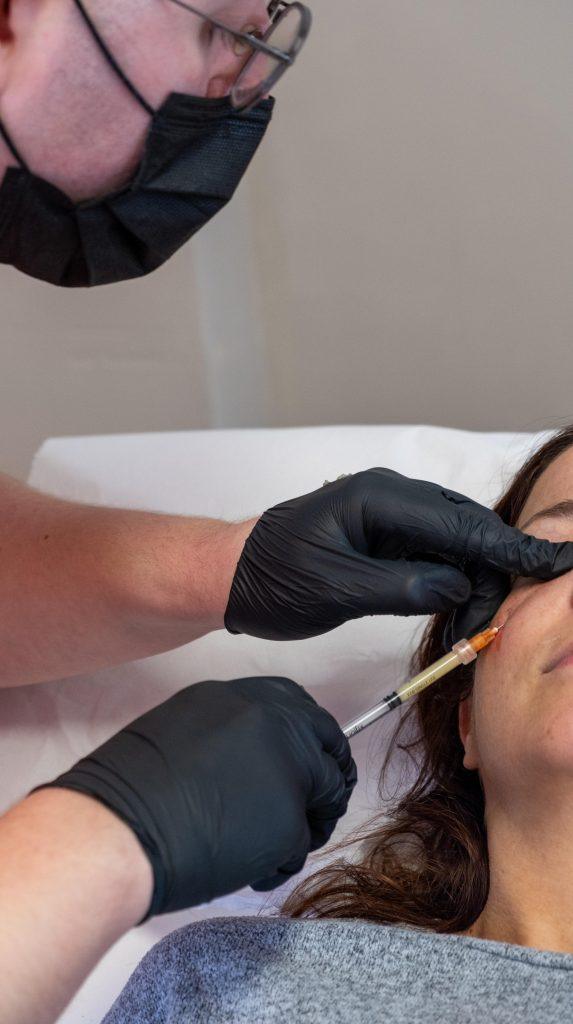
PRF biofiller is one of the most talked about treatments right now, and for good reason. It uses your own blood to restore lost volume from within, giving results that tend to look soft and authentic rather than overly obvious.
This quick guide covers what biofiller is, how PRF biofiller compares to regular filler, where it’s commonly used, and what a treatment actually involves.
We often see people asking what is biofiller? The short answer is that it’s a natural alternative to traditional dermal filler. Rather than introducing a synthetic substance into the skin, PRF biofiller uses a small sample of your own blood, processed into a gel and reintroduced into areas where volume has been lost.
For anyone who’s felt uncertain about putting an external substance into their skin, they can opt for PRF biofiller as it comes entirely from their own body.
Traditional filler tends to add volume from the outside in. It sits where it’s placed, holding its shape until it’s gradually broken down and needs topping up again. Plasma bio filler works differently, supporting the skin’s own environment so it can regenerate more effectively from within.
It encourages the skin to repair and rebuild itself, so the result tends to feel more like the skin restoring itself rather than being filled. Many people find this gives a softer, more natural outcome, since the change is happening at skin level rather than sitting on top of it.
PRF stands for Platelet Rich Fibrin, and fibrin is the reason this treatment behaves differently to standard PRP. Once your blood sample is taken, it’s spun at a lower speed than PRP and gently heated to form a gel with real structure, rather than staying as a liquid.
Where PRP is designed to be absorbed relatively quickly, this gel consistency means it holds its position in the treated area for longer, giving more direct, lasting support to areas of lost fullness.
Rather than treating the whole face in a general way, plasma bio filler targets only the areas where volume and skin density have started to reduce, making it a great approach to early signs of ageing. This targeted approach means the treatment plan can be built entirely around your own skin and concerns, rather than following a one-size-fits-all pattern.
The under-eye area is one of the first places volume loss tends to show, often appearing as hollowing or shadowing. Using bio filler under the eyes is one of the more common applications of this treatment, precisely because it responds well to the kind of gentle, structural support PRF biofiller offers.
Every case is different though, and suitability always comes down to an individual skin assessment, taking into account skin thickness, the extent of volume loss, and your overall goals.
That’s why every plan at Pumice & Willow starts with a proper consultation, including digital imaging to assess your skin condition before anything is agreed. This gives both you and us an honest picture of what’s realistic before any treatment goes ahead.
If the under-eye area is a concern for you, this is exactly the kind of thing to raise during your consultation with us, and we’ll be able to tell you honestly whether it’s the right approach for your skin, or whether another treatment might suit you better.
The process for plasma biofiller is straightforward and follows three clear steps, designed to make sure nothing is rushed and every decision is well informed. First, a detailed consultation looks at your skin concerns, medical history and what the treatment can realistically achieve for you.
From there, a personalised treatment plan maps out exactly which areas will be treated and how, so you know what to expect before you commit to anything.
On the day itself, a small blood sample is taken in a similar way to PRP. It’s then processed into a PRF gel, cooled, and carefully injected into the targeted areas using a fine technique designed to minimise discomfort.
The whole appointment typically takes between sixty and ninety minutes, and it’s entirely non-surgical, meaning there’s no downtime beyond some mild, short-lived swelling in the treated area.
This treatment tends to suit people noticing the early signs of ageing, such as reduced volume or fullness, who want a natural, non-surgical option rather than jumping straight to synthetic filler.
Because it uses your own plasma, PRF biofiller is often appealing to people who’d rather avoid introducing foreign substances into their skin, or who’ve had less predictable results with traditional filler in the past.
It can also work well alongside other treatments. Plasma bio filler is often combined with microneedling as part of a wider plan to support overall skin health between appointments, giving a more rounded, longer-term approach.
The best way to know if it’s right for you is a proper consultation with the team at Pumice & Willow, where your skin condition and goals are assessed properly before any recommendations are made.
Because plasma bio filler is a gradual, regenerative treatment, results build over time rather than appearing instantly. Since the treatment works with your skin’s own repair process, the improvement tends to develop naturally over the following weeks, which is part of what gives the results their soft, authentic look.
Your consultation will give you a clearer idea of what to expect for your specific skin, and a personalised treatment plan will set out how many sessions are likely to get you the results you’re after. Some people see the change they want after one session, while others benefit from a short course spaced a few weeks apart.
If you’d like to find out whether PRF biofiller is right for you, book a consultation with Sam, or get in touch with any questions first.