
A receding hairline is one of the most common signs of hair thinning, affecting a large proportion of men and a smaller but significant number of women.
At first, you might barely notice it: your hairline looks slightly higher, or your temples show a little more scalp than they used to. Then, over months or years, you realise it’s become much more obvious.
If you have started to notice your hairline creeping backwards, the good news is that there is a lot you can do, both to slow the process down and, in many cases, to encourage regrowth in the areas that are thinning.
Before you can tackle a receding hairline effectively, it helps to understand what is causing it. The most common cause by far is androgenetic alopecia. This is a genetic condition where hair follicles become increasingly sensitive to a hormone called dihydrotestosterone (DHT).
Over time, DHT causes the follicles to shrink, which leads to shorter, finer hairs and eventually to follicles that stop producing hair altogether.
Other factors can also play a role, including:
Identifying the underlying cause of your receding hairline matters, to find the right treatment.
The earlier you address a receding hairline, often the more options you have. Hair follicles that have fully closed down are much harder to reactivate than follicles that are miniaturised but still present.
This is why booking a consultation at Pumice & Willow is a great place to start. To understand your hair we will do a scalp examination and discuss your medical history, family history and lifestyle. This helps establish which treatment would be best for your hair.
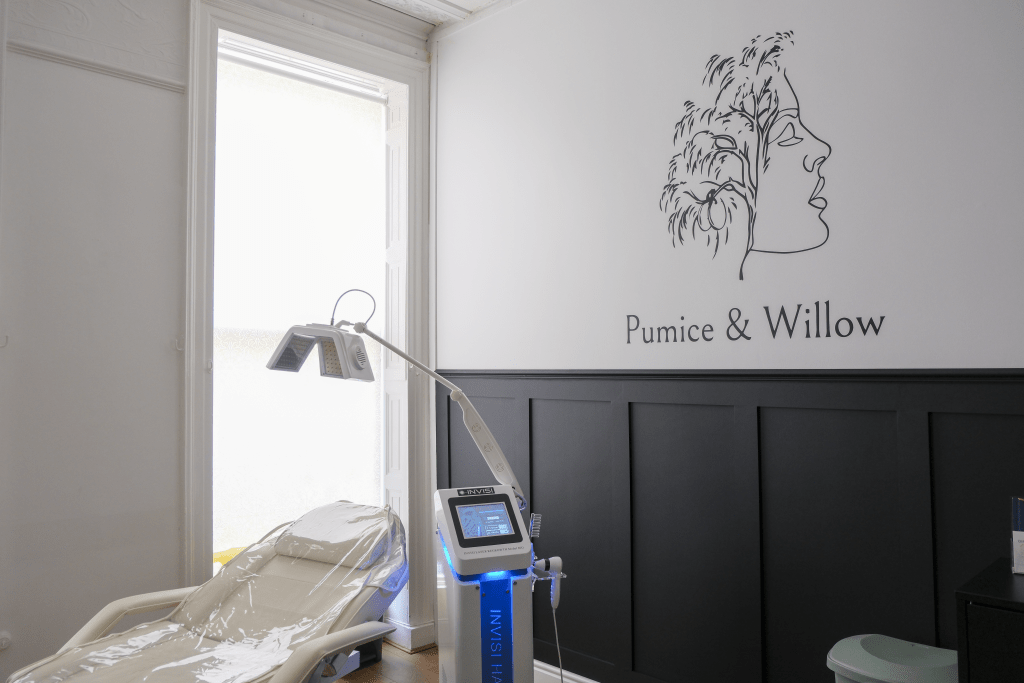
Laser hair regrowth uses red light wavelengths to stimulate cellular activity in the hair follicles, encouraging them into an active growth phase.
This is a lower-intensity option that some people use alongside other treatments, rather than as a sole solution for more advanced recession.
For more advanced recession, where follicles at the hairline have closed down completely, a hair transplant may be the most effective option.
At Pumice & Willow we offer hair transplant aftercare to help protect your results and support your recovery.
Depending on how much your hairline has receded you may need a combination of treatments.
It all comes down to your own circumstances. What works well for someone with early, mild thinning at the temples may not work for someone with more advanced recession.
A tailored plan, based on an accurate assessment of your hair gives you the best chance of a genuine improvement rather than wasted time and money on the wrong treatment.
If you have noticed your hairline receding over the past few months, it is worth booking a consultation rather than waiting to see how things develop.
Hair treatments are almost always more effective the earlier they are started, simply because there are more active, healthy follicles left to work with.
A proper consultation will look at your hair and scalp in detail, discuss your history and goals, and help you understand realistically what a treatment plan can achieve for your hair.
A receding hairline can feel disheartening, but it is rarely something you have to simply accept.
Between everyday scalp care and hair treatment options, there are more ways to address hairline thinning now than ever before. The key is to act early, get an accurate diagnosis, and build a plan suited to your hair, rather than relying on guesswork.