
Noticed your hair thinning? Find out what’s really behind it and which treatments work, with honest advice from Pumice & Willow.
A quick search for “hair treatments” throws up hundreds of products and procedures, all promising thicker, fuller hair. But which ones actually work?
We hear this from clients all the time, they’ve tried a few over-the-counter products with no real plan behind them, and come away feeling like nothing works.
The truth is, most treatments do work, but only when they’re matched to the right cause and used consistently. Here’s an honest look at what the evidence says, and how we help our clients find an approach that actually gets results.
Before looking at treatments, it’s important to understand why hair loss happens, because the cause largely determines what will and won’t help.
This is exactly why we start with a consultation for every client who we see at Pumice & Willow, rather than jumping straight to a product or procedure.
The most common form is androgenetic alopecia, also known as male pattern hair loss and female pattern hair loss. This is genetic and hormonal, driven by a sensitivity to a hormone called DHT, which gradually shrinks hair follicles until they stop producing visible hair.
It tends to follow a recognisable pattern: a receding hairline and thinning crown in men, and diffuse thinning across the top of the scalp in women.
Other causes include:
Getting the cause right matters because a treatment aimed at pattern hair loss won’t do much for hair loss caused by a nutritional deficiency, and vice versa.
This is why our assessments look at your history, lifestyle, and scalp health together, rather than treating hair loss as one single problem with one single fix.
There’s no shortage of options on the market, below include popular treatments and we offer all of these services except hair transplants, however we do offer hair transplant aftercare at Pumice & Willow as part of a tailored plan.
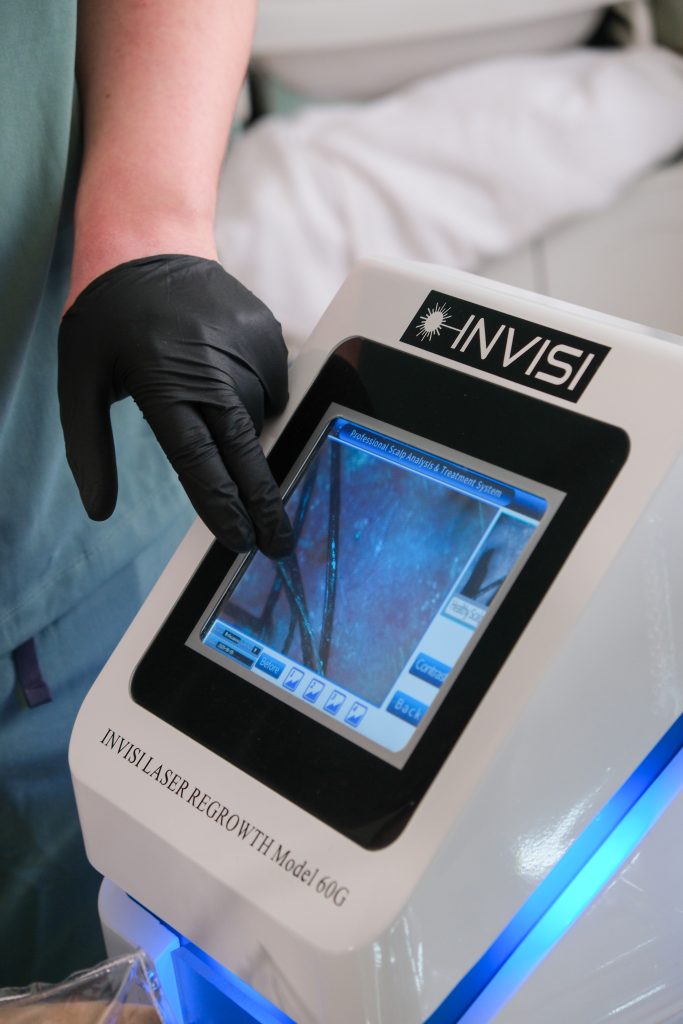
Low-Level Laser Therapy (LLLT) uses red light wavelengths to stimulate cellular activity in the follicles, delivered via a handheld device, and is available as part of our in-clinic treatment options. LLLT is considered very safe, non-invasive, and painless, because it utilises low-energy light rather than heat.
Hair transplants involve relocating healthy follicles from denser areas of the scalp to thinning ones, offering a more permanent, surgical solution. With the right aftercare, a hair transplant is a very effective treatment but it does include a surgical procedure followed by a 9-12 month recovery.
At Pumice and Willow we offer hair transplant aftercare to help make sure you get the best results from your procedure.
Patience is the most important thing when it comes to hair rejuvenation treatments. Hair grows in cycles, and follicles need time to shift from a resting phase into an active growth phase.
It’s something we thoroughly explain to every one of our clients at their first consultation, because realistic expectations make all the difference to how people feel about their results.
PRP typically requires a course of sessions spaced several weeks apart, with visible improvement building gradually over three to six months. Laser therapy follows a similar timeline.
Hair transplants have their own timeline entirely. Transplanted follicles usually shed within the first few weeks (a normal and expected part of the process) before new growth begins around three to four months later, with final results visible at around twelve months.
Whether hair loss can be reversed or just slowed depends heavily on the cause and how advanced the hair loss is.
For pattern hair loss, treatments generally work best at slowing progression and improving the health of follicles that are still active. Some regrowth is often possible, particularly in areas of early thinning, but follicles that have been dormant for a long time are harder to revive.
Hair loss caused by temporary factors, such as stress, illness, or nutritional gaps, is often fully reversible once the underlying cause is addressed. Once the trigger is resolved, hair usually grows back on its own over several months.
Hair transplants don’t reverse the underlying cause of hair loss, but they do provide a lasting cosmetic solution by moving hair that isn’t susceptible to the same pattern of loss.
Generally speaking, the earlier hair rejuvenation treatment begins, the better the outcome. People in the early to moderate stages of thinning, where follicles are weakened but still active, tend to respond best to non-surgical treatments.
Consistency also plays a huge role. Treatments like low level laser therapy, and PRP all rely on ongoing use or repeated sessions. This is one of the reasons we build ongoing plans with our clients rather than offering one-off treatments in isolation.
Those with very advanced hair thinning, where follicles have been dormant for years, are less likely to see significant regrowth from non-surgical treatments, and we’ll always be honest if another treatment is a more suitable route for you.
If you’ve noticed increased shedding, thinning, or a receding hairline, it’s worth speaking to us sooner rather than later. A proper consultation helps us build a treatment plan suited to your specific situation, rather than relying on trial and error with over-the-counter products.
Hair rejuvenation treatments aren’t one-size-fits-all, and what works well for one person may do very little for another. That’s exactly why we take the time to assess each client individually at Pumice & Willow, rather than offering a generic fix.
If you’d like to understand what’s really behind your hair thinning and which treatments could work for you, book a consultation with our team. We’ll talk you through your options honestly, with no pressure, so you can move forward with a plan that’s actually right for your hair.